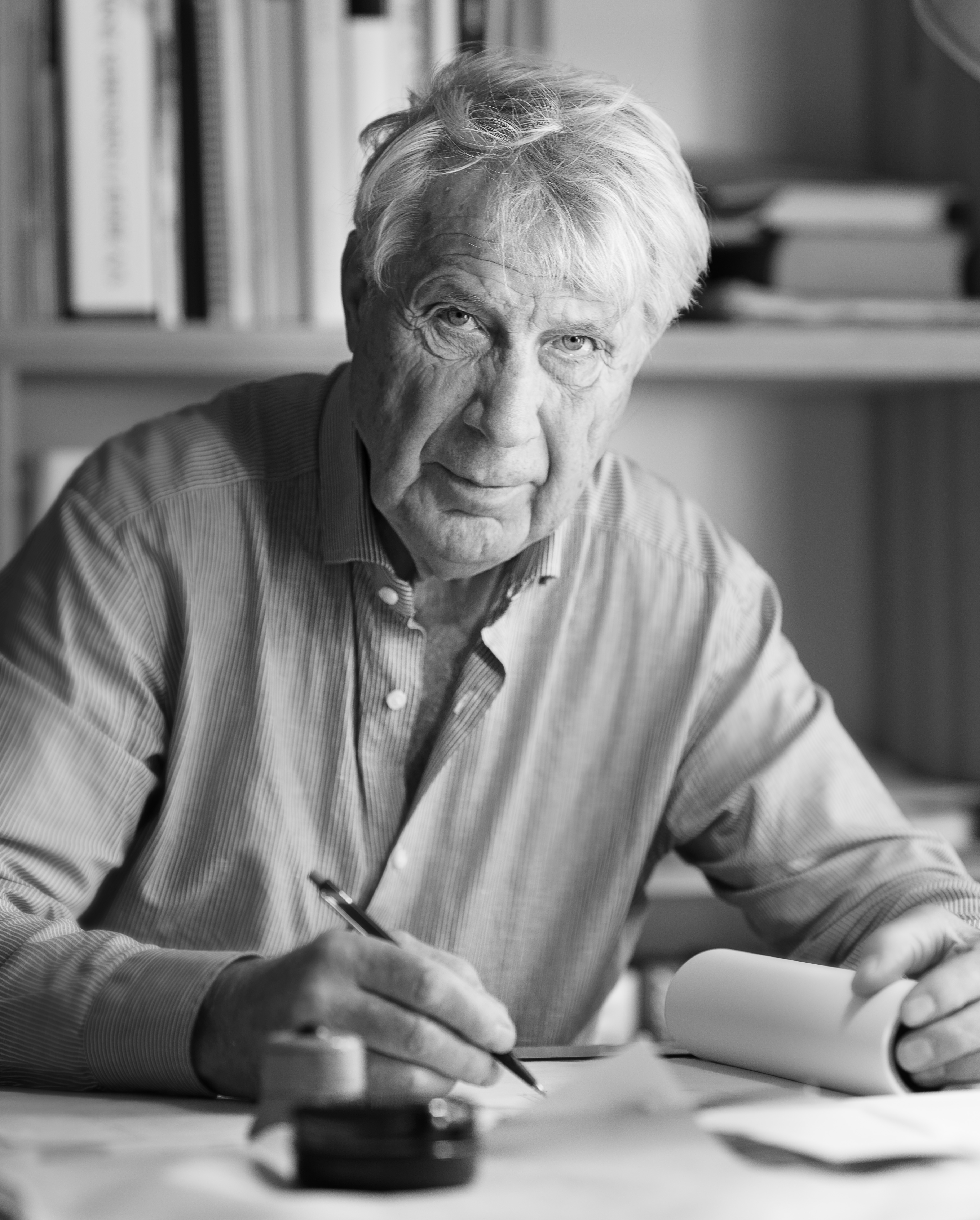
A tribute to Åke Axelsson
The interior architect and furniture designer Åke Axelsson has passed away at the age of 94. He left us peacefully on May 7, 2026.
This time of year was Åke’s favorite. He was filled with the flourishing of nature, the yellow forsythia bush beside the house in Engarn, the cherry tree by the workshop, and the potatoes that had to be planted, a symbolic act each year to maintain contact with the soil and his origins, the very foundation of Åke’s life’s work. “It sits in the hand,” he used to say.
Being able to sketch directly in wood and build furniture was essential to his long and extensive career, which made him a doyen in interior and furniture circles. The hand that builds, the eye that sees the whole, and the body that tests.
Sitting in one of Åke’s chairs is always comfortable.
He built and designed around 200 models, several of them modern classics: Vaxholmaren, Light & Easy, Akustik, Anselm, Linnea, Ararat, Gästis, Wood, most of them designed for the family-owned furniture company Gärsnäs. Anyone seriously engaged in modern functional furniture cannot avoid Åke Axelsson’s design.
He was active for eight decades, from the late 1950s into the 2020s, with public interior projects and furniture design. His extensive professional contribution made him one of the country’s most recognized, commissioned, long-serving, and award-winning interior architects and furniture makers. His furniture today exists across the full breadth of society: his armchairs in the ECOSOC chamber at the UN Headquarters in New York, a jubilee room at the Royal Palace, and furnishings in countless libraries, schools, churches, academies, museums, concert halls, art galleries, restaurants, and cafés. Åke is everywhere.
“Chair-Åke,” “Åke with the chairs.” He brushed off such labels. “I absolutely do not want to be a designer of chairs,” he emphasized that furniture should always be part of a whole. His interest was not spectacular design, but the needs of everyday life. The furniture was not only well known but also widely used and loved with particular warmth. “Of course, an Åke chair,” someone might say, and in that moment it became clear how deeply quality and design were meant to be felt.
Many of us have sat on Åke’s furniture, perhaps without recognizing it, simply experiencing that the comfort is good. Quite simply, comfortable chairs and armchairs. He called himself a functionalist, but in the true sense of the word, not a style, but function for a better life. Yet there is something more than utility in his furniture.
Åke had an elegant swing (he was a good dancer!), an artistic Axelsson dialect in which he subtly incorporated quotations and historical references from his predecessors, timeless qualities, and the wisest ways of working wood. Inspiration could come from carpentry in thousands-of-years-old Greek chairs or Egyptian stools, as well as from modernist formal solutions. Everything aimed at good, resource-efficient, durable furniture.
Åke Axelsson’s focus lay in the public space, in the environments where we as human beings meet and interact. He began working during the building of the Swedish welfare state. “My generation was lucky. We landed in a golden age,” he said. Many worked in the great societal project, but few names are surrounded by such respect and affection as Åke Axelsson’s. He became democracy’s interior architect, viewing the spaces of the public environment with a knowledgeable and enthusiastic eye, where human encounters stand at the center. His furniture was to support us in social life and work, present, yet understated and effective.
Åke Axelsson’s origins taught him the basics.
Growing up with seven siblings on a small farm in Skillingsmåla in Småland, he internalized the rules of self-sufficiency. The potatoes had to go into the ground, it was about survival. If a house was to be built, trees had to be felled in the forest and hauled home. “Everything is in the hands,” he used to say. That was typical of Åke and unusual in the architectural world, an interior architect who was also a cabinetmaker. He built what he needed himself, shaping furniture according to how it would function in its environment. From the early 1980s, his workshop and home were located in Engarn outside Vaxholm, where he lived and worked, built and designed. Åke worked in the analog world. Mobile phone, solar panels, and hybrid car, but no computer. He could draw dizzying plans with pencil on paper.
That Åke Axelsson had something special in his hands was discovered already in elementary school. Talents from the forest region were brought forward. He was sent to local carpentry courses and, at 15, to furniture-making school in Visby from 1947 to 1951. He was later educated under Carl-Axel Acking in the interior architecture program at Konstfack from 1952 to 1957, “a new world opened up for me.” Precociously mature, Åke found himself at extremes. First with the Bauhaus-inspired interior of the new Konstfack school at Gärdet in the early 1960s, then working under Peter Celsing with the luxurious environments of Operakällaren. Åke started his own office, won a competition for a chair in red beech, the now-classic S 217, which was serially produced by Gärsnäs for 55 years. That is sustainable design. Since last year, a bronze version of the chair has stood in Engarn.
At the end of the 1960s, Åke grew tired of leading his rapidly expanding office, stepped away, and started a joinery workshop at Vaxholm City Hotel. Somewhat romantically, he wanted to sell furniture over the counter. However, he had to continue with interior architecture, first with Peter Celsing on the Parliament Building and the Swedish Film Institute building, and then with other major commissions.
During the 1970s, Åke was a teacher of furniture design and interiors at Konstfack, where his design philosophy reached new generations of students who in turn spread the Axelsson insights further. One of the works he himself valued most highly is the interior of the Parliamentary Library in Gamla Stan (1992–96), a total environment where the history of Swedish democracy is accessible. In Karlskrona, the Reading Society Library (1990–93) is a concentrated atmosphere surrounding a unique 19th-century library that was recently saved from destruction after protests. The Värmland Museum library in Karlstad is a later Axelsson environment (2015–19).
In recent years, Åke Axelsson’s work was shown retrospectively, primarily in Denmark, a nation of master furniture makers, which welcomed him in the exhibition Velkommen Hjem, Åke at Galleri A. Petersen in Copenhagen in 2020–2021. He exhibited at Stockholms Auktionsverk in 2021, and at Sven-Harrys Art Museum with Talking to Åke (2022), a dialogue with younger designers.
Åke Axelsson often spoke of something other than style and aesthetics. “We have a responsibility for the future; it’s not just about making squiggles and figures.” An insight that must now be carried forward into the future of Swedish design. Åke will always be there as a good example and a wise and driven role model in design.
For more information, see the Gärsnäs website, Åke Axelsson’s Instagram, and the books Åke Axelsson – Den tidlösa formen (Carlsson, 2019) and Rum för oss alla – miljöer och mötesplatser 1957–2024 (Carlsson, 2024).
Text by: Petter Eklund